


Nature - 2019 March - Vol 567 No 7746
Publisher: Nature
Format: Paperback
ISBN: 9770028083095
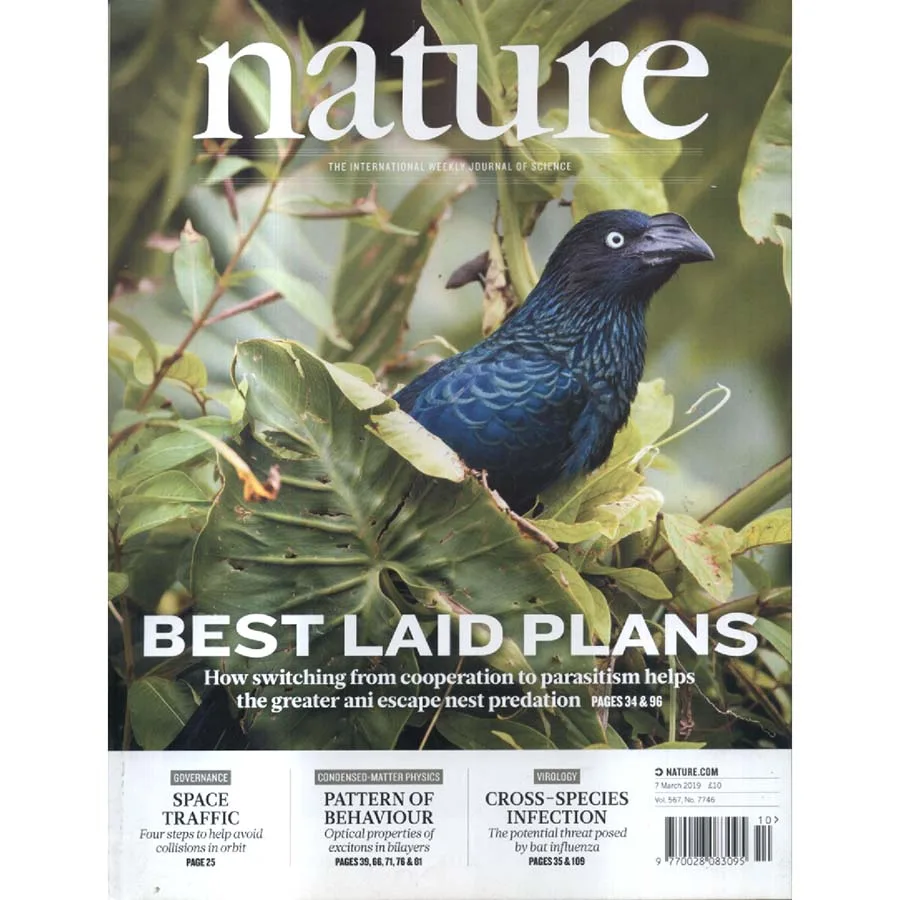
There are few magazines brave enough to place a deeply suspicious-looking tropical bird on the cover beneath the words “BEST LAID PLANS” and expect readers to immediately become interested in cooperative parasitism strategies. Yet this is precisely the sort of gloriously niche confidence that defines Nature – March 2019, Vol. 567 No. 7746.
The star of this issue is the greater ani, a bird which apparently survives nest predation by switching from cooperation to outright parasitism depending on circumstances. In other words, even tropical birds have discovered the corporate-management strategy of “teamwork until things get difficult”. Evolution, it seems, remains fundamentally committed to chaos.
The cover photograph is magnificent. The greater ani stares out from dense jungle foliage with the expression of a creature that absolutely knows more than it is telling scientists. Its pale eye gives it the look of an avian crime boss calmly overseeing complex social arrangements somewhere deep in the rainforest. One suspects the researchers spent years decoding these behaviours while the bird itself remained entirely unrepentant.
And naturally, because this is Nature, the issue refuses to stop at morally ambiguous birds. Elsewhere inside: space traffic management, condensed-matter physics, and cross-species viral infection. One moment you are reading about birds manipulating social systems for survival; the next humanity is trying to stop satellites crashing into each other while virologists quietly explain how bat influenza might leap species. It is less a magazine and more an expertly edited reminder that the universe is held together by systems nobody fully controls.
The “Space Traffic” feature is particularly wonderful in its understated phrasing. Humanity has filled orbit with enough machinery that Nature is now politely publishing advice on avoiding collisions in space, as though Earth has accidentally become a motorway service station for satellites. Meanwhile, condensed-matter physicists are studying “pattern of behaviour” in excitons, which sounds suspiciously like tiny subatomic particles attending therapy sessions.
One of the enduring pleasures of Nature is the editorial composure. The magazine never screams. It simply informs readers that orbital collisions, cross-species viral threats, and manipulative jungle birds are all active areas of scientific study, then carries on with dignified formatting and beautifully typeset captions. There is something almost comforting about that calmness.
Owning a copy of Nature also carries a very particular social energy. It suggests someone intellectually engaged with the frontiers of science and modern thought. Whether you have actually absorbed the detailed physics article or merely spent several minutes admiring the suspicious bird on the cover while feeling faintly underqualified is beside the point. The aspiration is part of the experience.
This March 2019 issue now feels like a remarkable snapshot of a world edging toward increasing complexity in every direction: ecosystems behaving strategically, space becoming crowded, viruses crossing species boundaries, and science attempting to keep pace with it all through peer-reviewed determination and extremely expensive imaging equipment.
Condition is listed as Good, meaning this copy has survived the normal hazards endured by elite scientific journals: backpacks overloaded with unread ambition, desks belonging to sleep-deprived researchers, coffee consumed dangerously close to important diagrams, and years of careful shelving by people convinced they would “definitely finish that article later”.
A superb issue for science enthusiasts, bird lovers with questionable morals, space-policy readers, or anyone who enjoys magazines that casually connect jungle parasitism, orbital congestion, and bat influenza under one elegant cover.
Keep browsing: See more Nature Journal books Other books by Nature
